UPI MDR Explained: What Changes From October 2026?
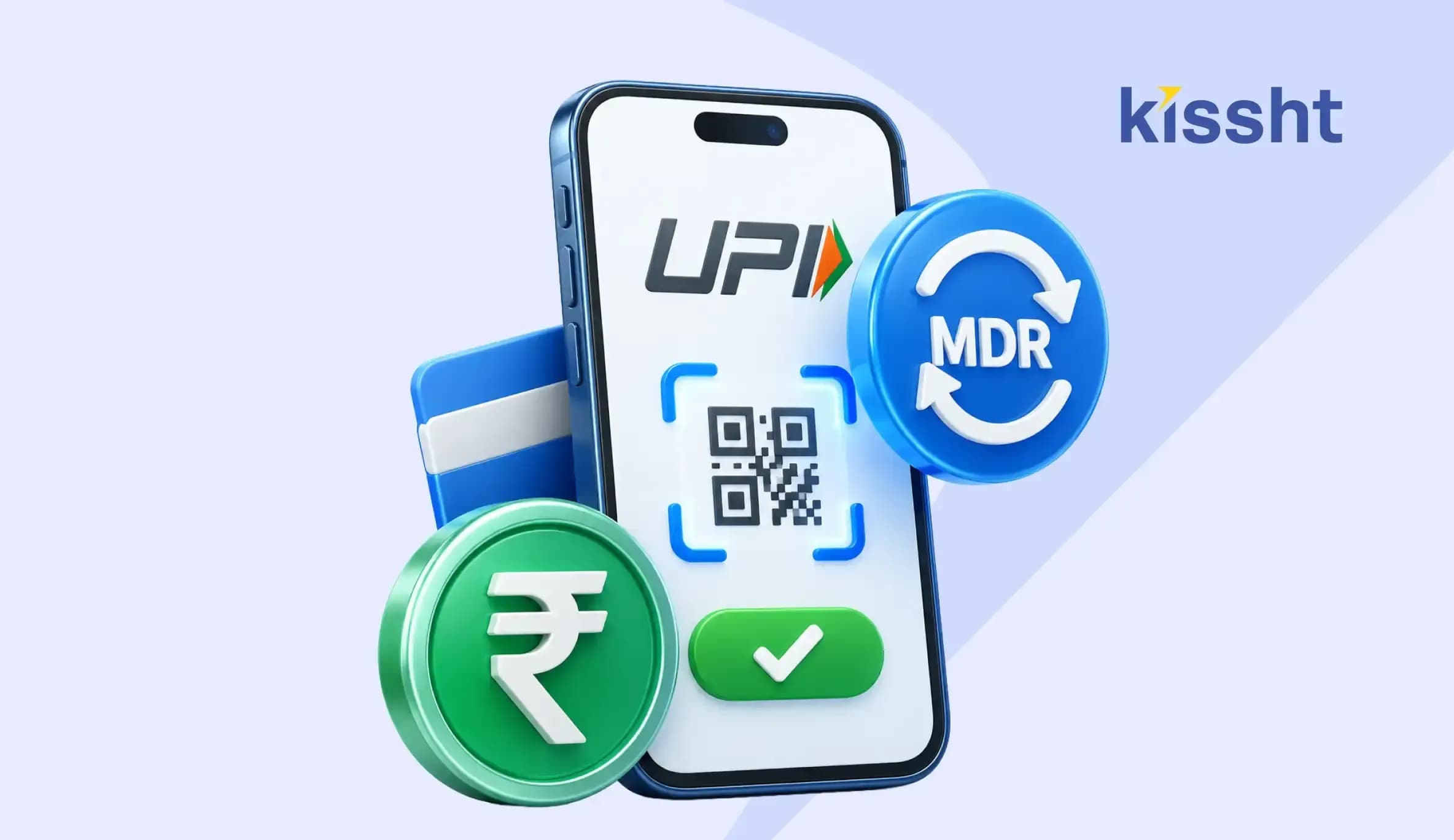
For millions of Indians, paying through UPI (Unified Payments Interface) has become almost second nature. Scan a QR code, enter the amount, authenticate the payment, and it is done. For merchants too, UPI has become an essential way of accepting payments. That familiar payment experience, however, will change significantly for merchants from 15th October, 2026.
A new Merchant Discount Rate (MDR) framework will come into effect for specified UPI transactions. The announcement has naturally raised questions among merchants and consumers alike: Will UPI payments now cost money? Who will actually pay the charge? Does every payment above Rs. 2,000 attract a fee? What happens to small shopkeepers? And why has a charge been introduced on a payment system that has traditionally operated with zero MDR? Read on to get answers to all your questions.
Merchant Discount Rate (MDR) on Select UPI Transactions
| UPI Transaction/Merchant Category | MDR Treatment |
|---|---|
| Standard P2M transactions up to Rs. 2,000 | Zero MDR |
| Standard P2M transactions above Rs. 2,000 | 0.4% |
| Standard P2M transactions of Rs. 75,000 and above | Capped at Rs. 300 per transaction |
| Certain specified categories, such as railways, telecom services, insurance and fuel, above Rs. 2,000 | Flat Rs. 5 per transaction |
| Eligible small vendors under the P2PM category receiving up to Rs. 1 lakh per month through UPI directly into their bank accounts* | Zero MDR |
*Merchants receiving more than Rs. 1 lakh in inward UPI payments for three consecutive months are transitioned from P2PM to P2M.
What is UPI MDRs?
The Merchant Discount Rate (MDR) is a fee charged to a merchant for processing certain digital payments received through UPI. It is a merchant-side transaction cost for processing eligible UPI payments, distributed within the UPI ecosystem to support payment infrastructure, innovation, cybersecurity, and customer service.
Under the new framework, the charge applies to specified merchant transactions rather than being a universal fee on every UPI payment. This distinction is important because UPI involves several different types of transactions:
| Type | Description |
|---|---|
| Person-to-Person (P2P) | Direct transfer of funds from one individual to another individual |
| Person-to-Merchant (P2M) | When an individual pays a registered commercial entity or business for goods or services |
| Person-to-Person-Merchant (P2PM) | A designated category for eligible small vendors receiving UPI payments directly into their bank accounts, subject to a monthly threshold |
A designated category for eligible small vendors receiving UPI payments directly into their bank accounts, subject to a monthly threshold
Will consumers have to pay for UPI from 15th October, 2026?
No, not under this MDR framework. The MDR is a merchant-side charge. A consumer paying for a product or service through UPI does not suddenly have to add an MDR amount to the bill.
For example, a consumer buys a product priced at Rs. 10,000 and pays through UPI. If the transaction falls under the standard eligible P2M category, the merchant-side MDR calculation would be:
10,000 x 0.4% = Rs. 40
That does not mean a consumer has to pay Rs. 10,040. Merchants cannot pass the MDR on to consumers when accepting payments through UPI. Consumers will pay Rs. 10,000 only. This makes it clear that MDR is not classified as a “UPI fee.”
Who actually pays the MDR?
MDR is a merchant-side charge, not an additional amount payable by the consumer. In other words, if a transaction falls under the applicable MDR framework, the merchant bears the processing charge. However, not every merchant transaction is automatically subject to the 0.4% MDR. The new framework distinguishes between transaction values and merchant categories.
How much MDR will merchants actually pay?
The answer depends on two things: the value of the UPI transaction and the type of merchant receiving the payment.
For standard P2M transactions, UPI payments up to Rs. 2,000 remain free of MDR. The 0.4% MDR applies to eligible transactions above Rs. 2,000, subject to the applicable caps and special-category rules.
| UPI Amount Received by Merchant | Standard P2M MDR |
|---|---|
| Up to Rs. 2,000 | Free |
| Above Rs. 2,000 | 0.4% |
| Rs. 75,000 and above | Capped at Rs. 300 per transaction |
Calculation of 0.4% MDR
For most standard P2M transactions above Rs. 2,000, the MDR is calculated at 0.4% of the transaction value.
| UPI Amount Received by Merchant | MDR Calculation | MDR |
|---|---|---|
| Rs. 1,500 | Below Rs. 2,000 threshold | Free |
| Rs. 2,000 | At threshold | Free |
| Rs. 3,000 | 0.4% of Rs. 3,000 | Rs. 12 |
| Rs. 10,000 | 0.4% of Rs. 10,000 | Rs. 40 |
| Rs. 50,000 | 0.4% of Rs. 50,000 | Rs. 200 |
The framework also caps the MDR for high-value transactions. Once a standard P2M transaction reaches Rs. 75,000, the MDR is capped at Rs. 300 per transaction. For example, a Rs. 1 lakh UPI payment would ordinarily have an MDR of Rs. 400 (0.4%). However, because of the cap, the applicable MDR would be limited to Rs. 300.
| Transaction Value | 0.4% Calculation | Actual MDR |
|---|---|---|
| Rs. 50,000 | Rs. 200 | Rs. 200 |
| Rs. 75,000 | Rs. 300 | Rs. 300 |
| Rs. 1,00,000 | Rs. 400 | Rs. 300 |
| Rs. 2,00,000 | Rs. 800 | Rs. 300 |
What is P2PM, and who qualifies as a small merchant?
P2PM is for small vendors receiving UPI payments directly into their bank accounts through UPI QR. Under the framework, eligible small merchants receiving up to Rs. 1 lakh per month through UPI can remain in this category with zero MDR.
| Small Merchant’s Monthly UPI Receipts | Category/MDR Treatment |
|---|---|
| Up to Rs. 1 lakh | P2PM - zero MDR |
| Above Rs. 1 lakh for one month | Does not, by itself, trigger the three-month transition |
| Above Rs. 1 lakh for 3 consecutive months | Transition to P2M |
If a small merchant receives more than Rs. 1 lakh through UPI in each of three consecutive months, the merchant is transitioned from P2PM to P2M. This means the merchant will no longer receive the zero-MDR benefit available under P2PM and will instead be subject to the applicable P2M MDR.
Conclusion
The introduction of MDR on select UPI transactions is an important change in how the UPI ecosystem supports its growing scale. UPI processes billions of transactions every month, and the MDR collected under the new framework will remain within the UPI ecosystem to support investments in infrastructure resiliency, innovation, cybersecurity and customer service.
At the same time, the framework is designed to keep UPI an affordable payment option for merchants. Under the framework, the standard 0.4% MDR applies to eligible P2M transactions above Rs. 2,000, while certain categories are subject to separate MDR structures. Eligible small-value transactions remain unaffected, and the framework also provides zero-MDR treatment for eligible small merchants under the P2PM category.
For consumers, the everyday UPI experience remains unchanged, with no separate UPI service charge being imposed on individual account holders. For merchants, however, understanding the applicable transaction category, threshold and MDR rules will become important once the framework takes effect on 15th October 2026.
FAQs
The Merchant Discount Rate (MDR) is a fee businesses pay for processing UPI payments, which is distributed within the UPI ecosystem.
Will UPI become chargeable for consumers from 15th October, 2026?
No. Consumers will not have to pay a separate UPI service charge under this MDR framework.
Does MDR apply if I transfer Rs. 50,000 to my parents?
No. A Rs. 50,000 transfer to your parents is a P2P (person-to-person) transaction, not a merchant payment. Under the framework, P2P UPI transactions remain free for both the payer and the beneficiary.
Will I have to pay MDR when I scan a merchant’s UPI QR code?
No. MDR is a merchant-side charge and cannot be passed on to the consumer as an additional UPI charge.
Does every UPI payment above Rs. 2,000 attract 0.4% MDR?
No. The 0.4% MDR applies to eligible standard P2M UPI transactions above Rs. 2,000. However, certain merchant categories are subject to different MDR rates, while eligible P2PM merchants can continue to receive UPI payments with zero MDR, subject to the applicable conditions.
What is the maximum MDR on a standard P2M transaction?
The MDR on a standard P2M transaction is capped at Rs. 300 per transaction for transactions of Rs. 75,000 and above.




Instant Loans at Your Fingertips


Personal Loan
Fast, hassle-free loan for your personal needs.

Business Loan
Fuel your business growth with quick approvals.

Loan Against Property
Unlock your property’s value with ease.

Credit Pulse
Boost your credit score with smart insights.

Track your credit score
Simply enter your mobile number to get a quick overview of your credit score.
Check Now
Related articles
Sept 23, 2026
What are the Common UPI Terms and Their Meanings?
Aug 28, 2026
Mutual Funds vs․ Stocks: What's the Difference?
Aug 28, 2026
Best Investment Options for Beginners
Aug 23, 2026
SIP Investment Guide for Beginners: Steps, Benefits and Risks
Aug 11, 2026
Different Types of Bank Accounts in India: Which One Should You Choose?
Aug 25, 2026
Form 26AS: Meaning, Details, Login & How to Download
Aug 25, 2026
50/30/20 Budget Rule: Your Simple Guide to Financial Management
Jul 28, 2026
8 Best Walking Pads for Home in India (2026): Top Foldable Picks for Everyday Fitness
Jul 27, 2026
How to Download Form 15G Online: Form 121 PDF, Eligibility and Submission Guide - 2026

31st Jul 2026
How to File a Cyber Crime Complaint in India - Step-by-Step Process
Jun 18, 2026

