What are the Common UPI Terms and Their Meanings?
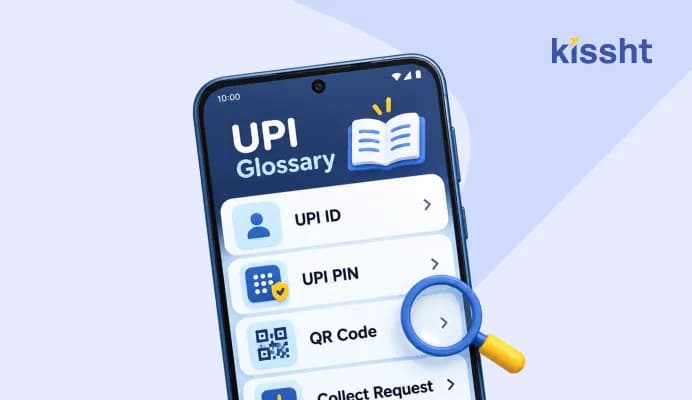
You start your morning by buying a cup of chai and scanning the QR code at a local tea stall. At lunch, you send your colleague Rs. 250 for the shared meal. In the evening, you pay your electricity bill through a UPI app and later get a notification that your monthly OTT subscription has been paid through UPI AutoPay. Four routine payments, four different ways of using UPI, and hardly a few seconds spent on any of them.
You may notice that each payment comes with its own set of terms. UPI ID, UPI PIN, P2P, P2M, UPI AutoPay, and UPI Transaction ID are all part of the payment ecosystem you use every day. Let’s break down the common UPI terms and what they mean at different stages.
What is UPI?
UPI, or Unified Payments Interface, is an instant real-time payment system developed by the National Payments Corporation of India (NPCI) that lets people transfer money directly between bank accounts within seconds. Registered users can make payments using a mobile number, UPI ID, or QR code without entering a bank account number or IFSC code for everyday transactions. UPI supports payments 24x7, including weekends and public holidays, which makes it convenient for both personal and merchant payments.
NPCI launched UPI in 2016, and it now powers payments across popular apps such as Google Pay, PhonePe, Paytm, and BHIM. UPI connects these apps through a common payment infrastructure, which means you can send money to someone even if they use a different UPI app. The system also supports person-to-person transfers, merchant payments, bill payments, and recurring payments through UPI AutoPay.
What is UPI MDR?
UPI MDR refers to the Merchant Discount Rate associated with a UPI transaction. MDR is a fee charged to a merchant for accepting a digital payment, where applicable. You can check the latest UPI MDR rules, effective from 15th October, 2026.
MDR remains relevant when discussing the economics of digital payments, especially for payment service providers, merchants, and different UPI-linked payment instructions. Registered users generally do not need to calculate MDR while making a normal UPI payment.
What is P2P UPI?
P2P UPI means Person-to-Person UPI. It refers to a UPI transaction where money is transferred from one individual to another. For example, if you send Rs. 500 to a friend for your share of a restaurant bill, the transaction is a P2P payment.
You can usually make a P2P UPI payment using the recipient’s UPI ID, mobile number, app-supported bank details, or by scanning their QR code. People commonly use P2P payments to split bills, send money to relatives, and make other personal transfers.
What is P2M UPI?
P2M UPI, or Person-to-Merchant UPI, refers to payments an individual makes to a business or merchant through UPI. Common examples of P2M transactions include paying a shopkeeper by scanning a QR code, paying an online retailer using UPI, or paying a service provider through a UPI-enabled checkout.
The merchant receives the payment into an account linked to its digital payment setup. P2M UPI has become a common way for consumers to pay businesses without using cash or entering card details.
What is P2PM UPI?
P2PM UPI refers to Person-to-Person-Merchant payments, a special category created by the NPCI for small vendors and street shops to accept digital payments directly into their personal bank accounts. Vendors do not need a commercial current account or GST registration.
What is a UPI ID?
A UPI ID, also called a Virtual Payment Address (VPA), is a unique identifier used to send and receive money through UPI without sharing your bank account number or IFSC code. It generally looks like an email address, such as name@bank or mobile@upi, depending on the UPI app or bank. Your UPI ID connects to your linked bank account and helps the payment system route money to the correct account.
You can create or find your UPI ID through a UPI-enabled app, subject to your bank's and app's services. You can share your UPI ID with someone who wants to send you money. Before making a payment, always check the recipient's name displayed on the payment screen to ensure that you are sending money to the intended person or merchant.
What is a UPI PIN?
A UPI PIN (Personal Identification Number) is a secret 4- or 6-digit number you create to authorise money transfers and digital payments through UPI apps. The PIN acts as an important security layer because it confirms that the account holder is authorising the transaction.
You must never share your UPI PIN with anyone, including someone claiming to be a bank employee, customer-care executive, or payment representative. Also, remember that you generally enter your UPI PIN to send or authorise money, not to receive money.
What is a UPI QR Code?
A UPI QR Code is a scannable square-shaped code that encodes payment details like the merchant's or individual's UPI ID and, sometimes, a fixed amount. Scanning the code can automatically populate the relevant payment details, reducing the need to enter a UPI ID manually.
Before entering your UPI PIN, check the recipient's name and payment amount displayed in your app. A QR code itself does not mean money will be credited to your account; the payment flow and authorisation shown by your UPI app matter.
What is a UPI Transaction ID?
A UPI Transaction ID, also known as the UTR (Unique Transaction Reference) number, is a unique 12-digit code generated for every single UPI payment. It acts as proof of the transaction and is what you'd quote while raising a complaint, tracking a delayed payment, or requesting a refund from your bank or the merchant. Every successful, failed, or pending UPI transaction gets its own UTR, making it the single most useful piece of information to have handy during a payment dispute.
What is UPI AutoPay?
Through UPI AutoPay, registered users set up recurring payments through a UPI mandate. It can be useful for payments such as OTT subscriptions, insurance premiums, utility bills, EMIs, and other recurring expenses, provided the merchant and bank support the facility.
The user authorises the mandate in advance, including relevant details such as the amount, frequency and validity period. Depending on the mandate and applicable rules, the system can then process payments automatically without requiring the user to initiate every transaction. Users should review the mandate details before approving them and cancel mandates they no longer need.
Conclusion
Undoubtedly, UPI has become the backbone of everyday payments in India. Terms such as UPI ID, UPI PIN, QR Code, Transaction ID, and UPI AutoPay are directly relevant to everyday users. In contrast, terms such as P2P, P2M, P2PM, and MDR explain different parts of the wider UPI ecosystem.
Quick note: Check the recipient’s name before confirming a payment, keep your UPI PIN private, review recurring mandates regularly, and save transaction details when you need to report a payment issue.
FAQs
Can merchants pass the MDR on to consumers?
No, merchants must bear the MDR entirely and cannot pass it on to consumers. Buyers will only pay the listed price of the product or service, with no additional surcharges for using UPI.
What is the difference between P2P UPI and P2M UPI?
P2P (Person-to-Person) UPI refers to fund transfers between individuals, while P2M (Person-to-Merchant) UPI refers to fund transfers from an individual to a merchant or business.
Is a UPI Transaction ID the same as a UPI ID?
No. A UPI ID is your permanent digital payment address for sending and receiving money. At the same time, a UPI Transaction ID is a temporary, one-time tracking code generated for a single specific payment.
Where can I find my UPI ID?
You can find your UPI ID by opening your UPI app, tapping your profile icon or picture, and selecting your bank account or UPI settings.
Is my UPI PIN the same as my ATM PIN?
No. Your UPI PIN authorises mobile and digital payments, whereas your ATM PIN authorises physical card and cash withdrawals.



Instant Loans at Your Fingertips


Personal Loan
Fast, hassle-free loan for your personal needs.

Business Loan
Fuel your business growth with quick approvals.

Loan Against Property
Unlock your property’s value with ease.

Credit Pulse
Boost your credit score with smart insights.

Track your credit score
Simply enter your mobile number to get a quick overview of your credit score.
Check Now

Related articles
Sept 15, 2026
UPI MDR Explained: What Changes From October 2026?

Aug 28, 2026
Mutual Funds vs․ Stocks: What's the Difference?
Aug 28, 2026
Best Investment Options for Beginners

Aug 23, 2026
SIP Investment Guide for Beginners: Steps, Benefits and Risks
Aug 11, 2026
Different Types of Bank Accounts in India: Which One Should You Choose?
Aug 25, 2026
Form 26AS: Meaning, Details, Login & How to Download
Aug 25, 2026
50/30/20 Budget Rule: Your Simple Guide to Financial Management
Jul 28, 2026
8 Best Walking Pads for Home in India (2026): Top Foldable Picks for Everyday Fitness
Jul 27, 2026
How to Download Form 15G Online: Form 121 PDF, Eligibility and Submission Guide - 2026
31st Jul 2026
How to File a Cyber Crime Complaint in India - Step-by-Step Process

Jun 18, 2026

