Documents Required for GST Registration
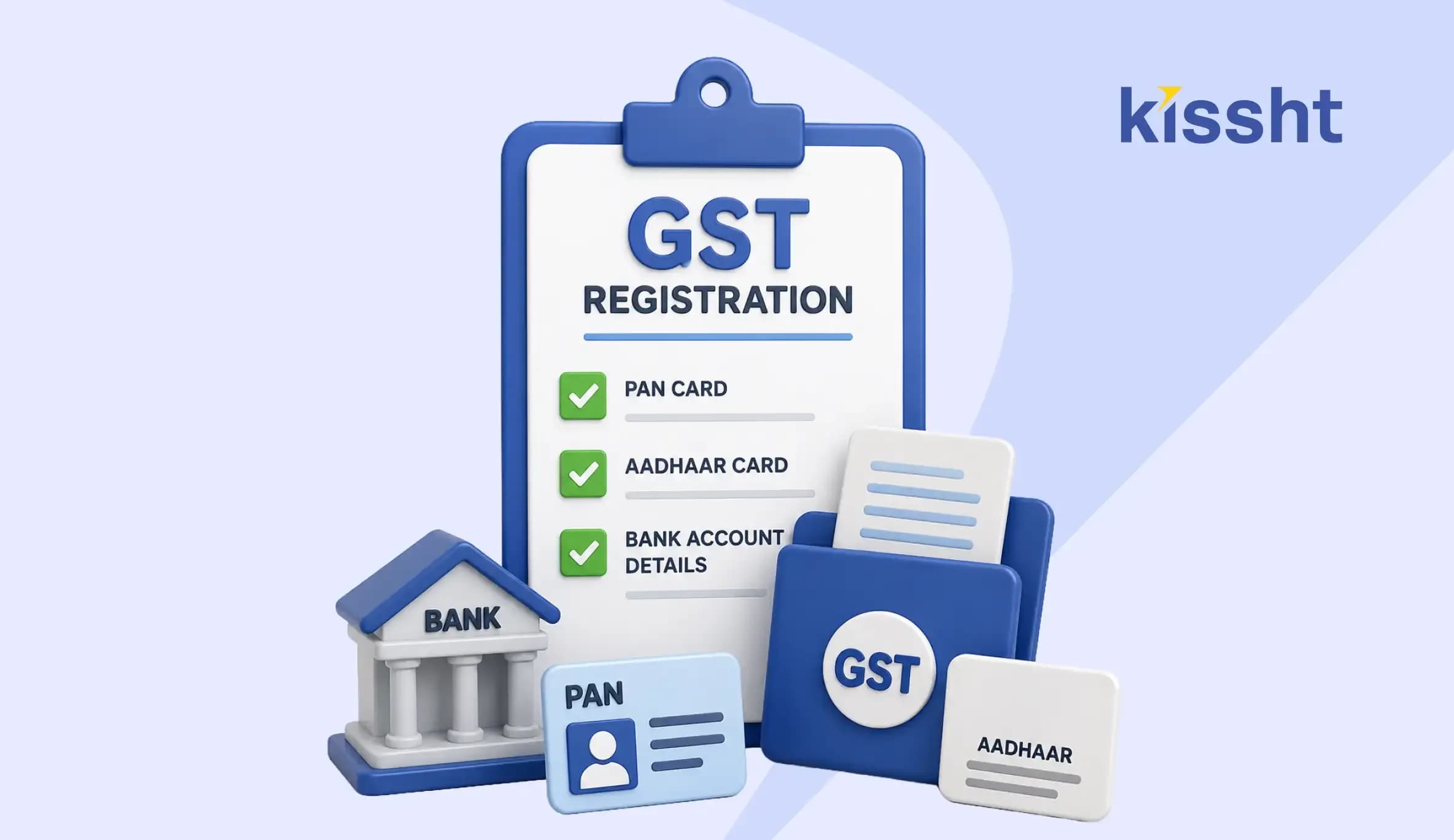
GST stands for Goods and Services Tax, a unified indirect tax system introduced to simplify taxation in India. For eligible businesses, GST registration is an essential step to collect GST from customers, claim Input Tax Credit (ITC), and comply with tax regulations. Businesses that meet the eligibility criteria need to complete the registration process and submit accurate GST documents to receive their GSTIN (Goods and Services Tax Identification Number).
But applying for GST registration becomes easier only when you are aware of the exact paperwork needed. This guide explains the documents required for GST registration, the eligibility conditions, the GST registration process, and the common mistakes businesses should avoid while preparing their application.
What is GST registration for business?
GST registration is the process through which a business obtains a unique GSTIN. This number is issued by the government and is required for businesses that cross the prescribed turnover limit or fall under specific categories requiring mandatory registration.
A registered business can:
- Issue valid GST invoices to customers
- Claim ITC on eligible purchases
- Build trust with customers and suppliers
- Expand operations across different states
- Claim other benefits under the relevant GST Rules & Act
Note: For any updates related to GST registration requirements, visit the official GST portal.
Documents required for GST registration
The GST registration documents required depend on the type of business structure.
1. Proprietorship Business
- PAN card of the owner
- Aadhaar card of the owner
- Photograph of the owner
- Proof of business address
- Proof of business constitution
- Bank account details
- Proof of business registration, if applicable
2. Partnership firm
- Partnership deed
- PAN card of the firm
- Identity, address proof, and photographs of partners
- Business address proof
- Bank account details
- Authorisation letter
- Business registration certificate, if applicable
3. Private limited company
- Certificate of Incorporation
- Company PAN card
- Memorandum of Association (MOA)
- Articles of Association (AOA)
- Valid Class 3 Digital Signature Certificate (DSC)
- Identity proof of directors
- Registered office address proof
- Bank account details
- Board authorisation document
4. LLP and other organisations
- Entity PAN card
- Certificate of Legal Setup
- Constitutional Bylaws document
- Identity, address proof, and photographs of every working director, partner, or trustee
- Authorisation Letter/ Board Resolution
- Business address proof
- Valid Class 3 Digital Signature Certificate (DSC)
- Bank account details
Note: For any updates related to the GST registration documents list, visit the official GST portal.
Step-by-step online GST registration process
The GST registration process is completed through the online GST portal. Here are the basic steps:
- Visit the official GST portal
- Go to the ‘Services’ option
- Select the ‘New Registration’ option
- Enter basic business details
- Verify details through OTP
- Fill out the registration form
- Verify details and generate a Temporary Reference Number (TRN)
- Log in using TRN and complete the application
- Scan and upload the required business documents for GST registration
- Submit application
- Receive an Application Reference Number (ARN)
- Receive GSTIN within 3 to 7 working days
How to update GST registration details after registration?
Depending on the type of change, businesses may need to submit revised GST application documents on the official portal within 15 days of the change.
1. Amendment of core fields
Core fields are important registration details that require approval from the tax authorities before the changes become effective. These include:
- Legal name of the business (where PAN remains unchanged)
- Principal place of business (other than a change in the State)
- Additional place of business (other than a change in the State)
- Addition/deletion of stakeholders
2. Amendment of non-core fields
Non-core fields can generally be updated online without approval from the tax authorities. These include fields other than core fields.
3. Non-amendable GST registration fields
You need to make a fresh application for GST registration in the following cases:
- Change in PAN
- Change in constitution of business resulting in change of PAN
- Change in place of business to another State
Tips to avoid rejection of GST registration
Many GST registration applications get delayed because of small errors. Keep these points in mind:
- Choose the appropriate taxpayer category
- Ensure your name and date of birth are identical on PAN and Aadhaar cards
- Upload valid and clear address proof matching your business location
- Select the correct business structure
- Verify your State and Ward/Circle details
- Reply to GST notices within the specified timeline
- Provide details of a current account registered in the business’s name instead of a personal savings account
- Enter an active mobile number and email ID to receive OTPs and official communications
Conclusion
A well-prepared GST registration application can save time and help avoid unnecessary delays. Once your GST registration is approved, your business can claim eligible ITC, issue GST invoices, and build credibility with its customers, suppliers, and financial institutions.
Moreover, when it’s time to invest in business growth, eligible borrowers can apply for a business loan with Kissht, an instant loan app. Before taking the next step, the business loan EMI calculator can help understand estimated monthly repayments and plan finances accordingly.
FAQs
-
What documents do I need for GST registration?
The GST registration documents include PAN card, Aadhaar card, business address proof, bank account details, photographs, and business-specific documents.
-
Who is eligible for GST registration?
GST registration is mandatory for businesses that cross the prescribed turnover limit or fall under specified registration categories. Businesses below the threshold may choose voluntary GST registration.
-
Can I complete GST registration online?
Yes, businesses can complete GST registration online through the official GST portal by submitting required details and uploading supporting documents.
-
How long does GST registration take?
The timeline depends on the accuracy of submitted details and successful verification. Normally, it takes 3 to 7 working days with Aadhaar authentication.
-
Can I get a GST registration if my business turnover is below the threshold?
Yes. Businesses with turnover below the prescribed threshold can apply for voluntary GST registration.




Instant Loans at Your Fingertips
Apply nowPersonal Loan
Fast, hassle-free loan for your personal needs.

Business Loan
Fuel your business growth with quick approvals.

Loan Against Property
Unlock your property’s value with ease.

Credit Pulse
Boost your credit score with smart insights.

Track your credit score
Simply enter your mobile number to get a quick overview of your credit score.
Check Now

Related articles

Aug 20, 2026
Chakshu Portal: What to Do When You Receive a Fraudulent Communication?

Jul 15, 2026
How Much Loan Can You Get for a Food Franchise Business?

Aug 10, 2026
Independence Day Special: 10 Smart Money Habits to Build Financial Freedom
Jul 23, 2026
What Is the Difference? MSME Loan vs Business Loan

Jul 22, 2026
EPF New Rules 2026 Explained: Withdrawal, Contribution, Wage Ceiling & Key Changes

Jul 20, 2026
How to Check EPFO Pension Status Online Using PPO Number (2026)

Jul 21, 2026
Top Reasons for MSME Loan Rejection
Jul 16, 2026
How to Check FASTag Balance Online: Vehicle Number, App, SMS & Missed Call (2026)
Jul 10, 2026
List of Best Mileage Bikes in India (2026)

Jul 13, 2026
Personal Loan vs MSME Loan: Which is Better for Business Needs?

Jun 28, 2026
How to Change Address in Passport: Complete Guide for India 2026

Jun 29, 2026

